
Hear from Our Customers
Right now, if you have a flat or low-slope roof in Peoria, your roofing system is likely making your HVAC work harder than it should. Roof surface temperatures here regularly hit 160°F in July — and that heat doesn’t stay outside. It moves through your roof, into your attic, and straight into the living space your air conditioner is already struggling to keep up with. Spray polyurethane foam roofing creates a seamless, continuous insulating layer that stops that heat transfer at the source. Most Peoria homeowners see cooling costs drop 25 to 35 percent after installation — which works out to roughly $960 back in your pocket every year on a typical home.
Then there’s monsoon season. If you’ve owned a flat-roof home in Peoria for more than a few summers, you already know what July and August can do. Intense storms, fast-moving water, and any seam or joint in your roofing system becomes a liability. Foam roofing is applied as a liquid and cures into one solid, unbroken membrane — no seams, no joints, no fasteners. There’s nothing for water to find its way through. For homeowners in Desert Harbor, Arrowhead Shores, or the established neighborhoods near the Loop 101, that kind of waterproofing isn’t a selling point — it’s a relief.
The long-term math works too. A properly maintained foam roof in Arizona’s climate can last 30 to 50 years. Most conventional flat-roof systems here need full replacement every 10 to 15 years. Over three decades, that’s two or three replacements you avoid entirely — plus the energy savings compounding the whole time.
We’ve been operating in Peoria and Maricopa County since 1999. That’s before Vistancia broke ground. Before the Loop 303 corridor started filling in. Before the northwest Valley became what it is today. That kind of track record isn’t something you manufacture — it’s built one roof at a time, one monsoon season at a time, over 25 years of showing up and standing behind the work.
Every foam roofing installation we complete comes with a 25-year workmanship warranty. Not a material warranty that passes the buck to the manufacturer — a workmanship warranty that covers how the roof was installed. That’s us putting our own name and money behind every project. We also hold a Certified Master Roofer designation, manufacturer certifications from GAF and Firestone, and the Arizona ROC C-42 license that specifically authorizes urethane foam roofing — all verifiable before you sign anything.
When a storm rolls through Peoria and your inbox fills up with flyers from contractors you’ve never heard of, the difference between a licensed Maricopa County company with a 25-year track record and a storm-chasing crew passing through is not subtle.
It starts with a real inspection — not a visual guess. We use thermal imaging technology to detect moisture hiding beneath your existing roof surface. In Peoria’s climate, where monsoon season can push water into a roofing system through cracks that are invisible to the naked eye, this step matters more than most contractors will admit. Installing foam over a wet or compromised substrate leads to adhesion failure and dramatically shortened roof life. The thermal scan eliminates that risk before any work begins.
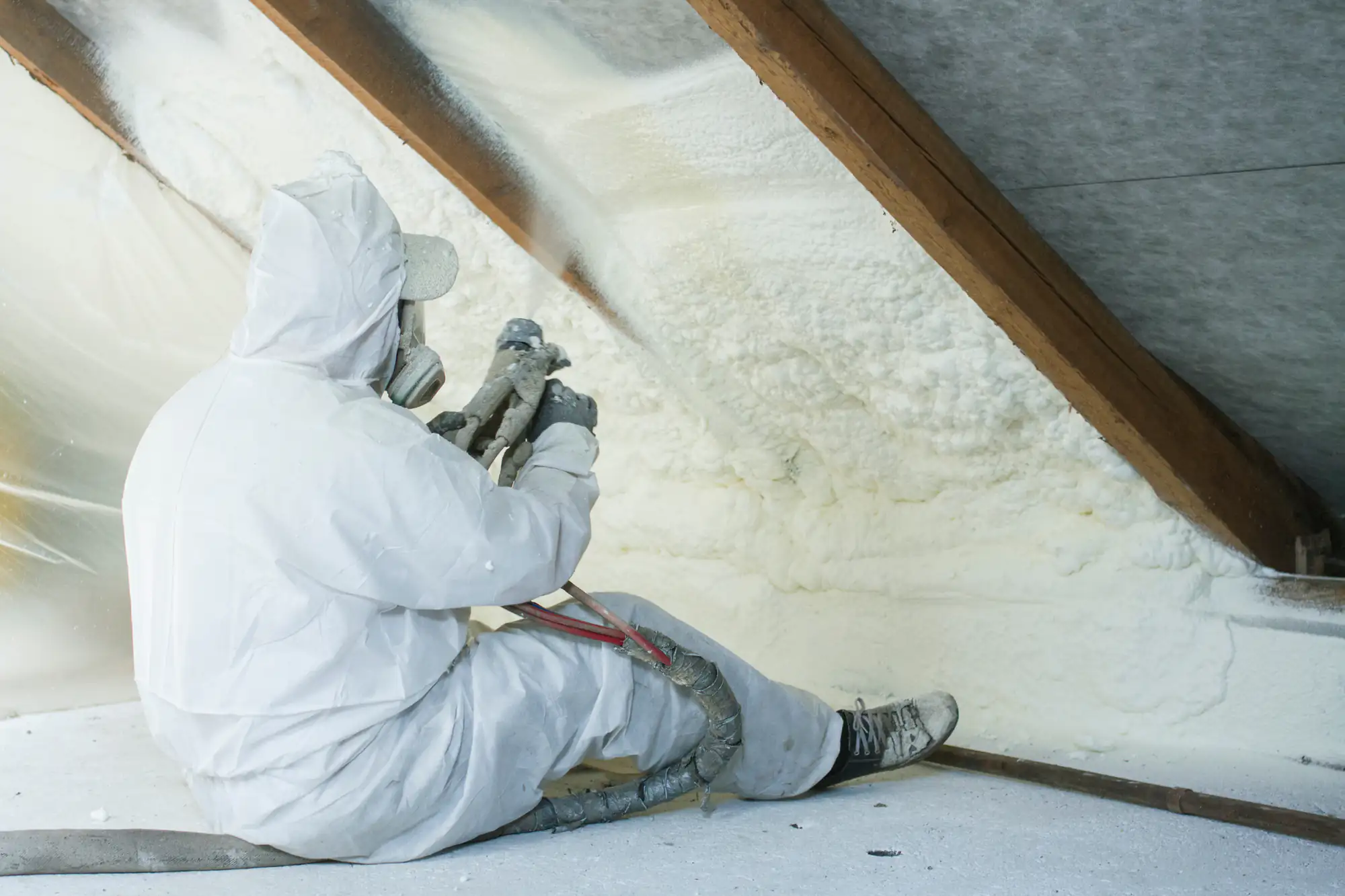
Once the substrate is confirmed clean and dry, the existing roof is prepared — cleaned, repaired where needed, and primed for adhesion. The spray polyurethane foam is then applied in a controlled pass, building up to the correct thickness for your roof’s slope and drainage requirements. After the foam cures, a UV-protective elastomeric coating is applied over the top. That coating is the sacrificial layer — it takes the brunt of Peoria’s 299 days of annual sun exposure so the foam underneath doesn’t have to.
Because the City of Peoria requires building permits for major roofing work, we handle the permitting process as part of every installation. You don’t have to chase down paperwork or navigate the Development Services office — that’s handled. Every project is permitted, inspected, and documented before it’s considered complete.
Ready to get started?
Foam roofing in Peoria isn’t a one-size situation. The residential side covers flat and low-slope roofs across Peoria’s full range of neighborhoods — from the lakefront homes in Desert Harbor and Arrowhead Shores to the newer construction in Vistancia and Westwing Mountain. Whether your roof is aging out of its current system or you’re proactively upgrading for energy performance, the installation process is the same: thermal inspection first, proper substrate prep, foam application at the right thickness, elastomeric coating on top, full permitting with the City of Peoria.
On the commercial side, Peoria’s rapidly developing Loop 303 corridor — including the North Peoria Gateway and the new Amkor Technology semiconductor campus area — is adding significant square footage of flat commercial and industrial roofing to the local market. Foam roofing is particularly well-suited to large commercial flat roofs. On a 20,000-square-foot building, annual energy savings can exceed $8,400, with a full payback period of three to four years. After that, every year the roof performs is straight savings.
Recoating is part of the long-term picture too. In Arizona’s UV environment, the elastomeric coating that protects your foam needs to be refreshed every five to seven years. Each recoating cycle extends your warranty coverage and keeps the foam itself — which doesn’t degrade under UV — fully protected. It’s a maintenance model that makes sense: a small, periodic investment that keeps a 30-to-50-year roofing system performing at full capacity.
For a typical residential installation in Peoria, spray foam roofing generally runs between $7,000 and $12,000 depending on the size of the roof, its current condition, and any prep work required before foam can be applied. That range puts it above some alternatives upfront, but the comparison changes significantly when you factor in what you’re not spending over the next 30 years — no full replacement every 10 to 15 years like you’d face with conventional flat-roof systems, and annual energy savings in the $800 to $1,000 range on a typical Peoria home.
The payback period on a foam roof in this climate is typically under four years. After that, you’re generating savings every single month on your APS bill while the roof continues to perform. We also offer financing options, which means you can start capturing those energy savings immediately without absorbing the full installation cost upfront. Transparent, upfront pricing with no hidden costs is standard on every project — you’ll know exactly what you’re paying before any work begins.
Yes — and it’s specifically designed to handle exactly what Peoria’s monsoon season throws at a flat roof. The reason conventional flat-roof systems fail during monsoons comes down to seams. Every joint, fastener, and seam in a traditional roofing membrane is a potential entry point for water, and when you’re getting a fast, heavy downpour on a flat surface, water finds those entry points. Spray polyurethane foam is applied as a liquid and cures into a single, continuous membrane with no seams, no joints, and no fasteners. There’s nothing for the water to exploit.
What makes this particularly relevant in Peoria is the northwest Valley’s storm pattern. Monsoon storms here can be intense and fast-moving, and flat-roof homes in neighborhoods like Arrowhead Shores or the established areas near Bell Road don’t get a slow, steady rain — they get volume, fast. A seamless foam roof handles that load without the vulnerabilities that cause post-monsoon leak calls. The elastomeric coating on top also adds a waterproof barrier that sheds water cleanly and resists the UV degradation that would otherwise compromise the system between monsoon seasons.
In Arizona, the general rule is every five to seven years — and Peoria’s sun exposure is exactly why that interval matters. The foam itself is not what degrades under UV exposure. It’s the elastomeric coating on top — the layer that’s intentionally designed to take the punishment so the foam underneath doesn’t have to. When that coating starts to thin or show wear, a fresh recoat restores the UV protection and keeps the foam performing as intended.
The recoating process is significantly less disruptive and less expensive than any kind of roof replacement. It typically involves cleaning the surface, making any minor repairs to the foam, and applying a fresh coat of elastomeric coating. Each recoating cycle also typically extends your manufacturer warranty coverage for an additional 15 years. So rather than thinking about a foam roof as something that eventually needs to be replaced, think of it as a system that gets renewed periodically — at a fraction of the cost of starting over with a new roofing system.
Yes. The City of Peoria requires a building permit for major roofing work, including new foam roof installations and full replacements. Work cannot legally begin until permits are obtained and inspection fees are paid. The contractor you hire also needs to hold an active Arizona Registrar of Contractors license — specifically the C-42 Roofing classification, which is the license that explicitly authorizes urethane foam roofing. A general contractor license is not the same thing, and not every roofing company that offers foam roofing holds the right classification.
This matters more than most homeowners realize. Roofing work done without the proper permits in Peoria can void your homeowner’s insurance coverage and create liability issues if something goes wrong. After major monsoon events in the northwest Valley, it’s common to see out-of-state contractors offering quick repairs without pulling permits or holding Arizona ROC licenses. We handle all permitting through Peoria’s Development Services department as a standard part of every installation — and you can verify the Arizona ROC license at roc.az.gov before signing anything.
Both are legitimate flat-roof options, but they perform differently in Peoria’s specific conditions. TPO is a membrane system — it’s installed in sheets that are seamed together, usually with heat welding. Done well, TPO seams hold up. Done poorly, or stressed repeatedly by Peoria’s thermal cycling — where roof surfaces can swing from 160°F in July to much cooler overnight temperatures — those seams become the weak point. TPO also has a lower insulation value than foam, which matters a great deal in a climate where cooling costs are the primary driver of energy bills.
Spray polyurethane foam delivers R-6 to R-7 of insulation value per inch — the highest of any roofing material — and eliminates the seam issue entirely by curing into a single, continuous membrane. It also adds insulation value that TPO simply doesn’t provide. The tradeoff is that foam requires more skill to install correctly and needs periodic recoating, while TPO is more forgiving of installer variation. For Peoria homeowners prioritizing long-term energy performance and monsoon-season waterproofing, foam typically wins on lifecycle cost. For someone focused purely on upfront installation cost, TPO may come in lower initially — though the energy savings gap closes that difference over time.
Absolutely — and commercial flat roofs in that corridor are actually where foam roofing’s advantages show up most clearly in the numbers. Industrial and commercial buildings along the Loop 303, including the facilities going up near the North Peoria Gateway and the Amkor Technology campus area, typically have large, flat roofs that are expensive to heat and cool. Spray polyurethane foam’s insulation value — R-6 to R-7 per inch — applied across a 20,000-square-foot commercial roof can reduce annual energy costs by $8,400 or more, with a full payback period of three to four years.
Foam roofing also works well as a retrofit on existing commercial buildings because it can be applied directly over a structurally sound existing roof in many cases, eliminating the cost and disruption of a full tear-off. For property owners and managers making roofing decisions for Peoria’s growing commercial inventory, the lifecycle cost argument for foam is straightforward: higher upfront than some alternatives, significantly lower over a 20 to 30-year horizon when energy savings, avoided replacements, and reduced repair frequency are factored in. We handle commercial foam roofing projects in Peoria with the same permitting, thermal inspection, and workmanship warranty standards as residential work.
Other Services we provide in Peoria