
Hear from Our Customers
Chandler roof surfaces routinely hit 160°F during peak summer months. That heat doesn’t stay outside — it pushes straight through conventional roofing materials and into your living space, forcing your air conditioning to work overtime from June through September. Spray foam roofing creates a continuous thermal barrier rated at R-6 to R-7 per inch — the highest insulation value available in any roofing material — and it does it without a single seam for heat to sneak through.
The energy impact is real. Chandler homeowners on SRP or APS typically see cooling costs drop 25 to 35 percent after a foam roof installation. On a $400 summer electricity bill, that’s $100 to $140 back in your pocket every month of the season. Over five summers, that math adds up to a significant portion of your installation cost recovered — just from what you’re no longer paying the utility company.
Then there’s monsoon season, which runs officially from June 15 through September 30 and brings the kind of storms that find every weakness in a flat roof. Microbursts, haboob-driven wind loads, and heavy rain all target the same spots: seams, joints, and flashing edges. A foam roof has none of those. It’s applied as a liquid and cures into one continuous surface with no gaps, no joints, and nowhere for water to enter. For anyone in Ocotillo, Dobson Ranch, or the flat-roofed commercial buildings along the Price Corridor, that’s not a minor upgrade — it’s the difference between a dry building and a claim.
We’ve been working in Maricopa County since 1999 — before much of South Chandler’s current housing stock was built, before Intel’s Ocotillo campus became the anchor of the entire East Valley tech economy. That’s not a marketing line. It means our crew has worked through decades of Chandler monsoon seasons, understands how the desert heat attacks specific roofing materials over time, and knows the City of Chandler’s permitting requirements firsthand.
We hold a Certified Master Roofer credential, an Arizona ROC C-42 license — the classification that specifically covers urethane foam installation — and manufacturer certifications from GAF and Firestone. Our 25-year workmanship warranty covers the installation itself, not just the materials. No competitor actively marketing foam roofing in Chandler offers a comparable workmanship warranty.
We’re based here, licensed here, and accountable here. You’re not hiring a company that showed up after a storm and will be gone by spring.
It starts with an inspection — and not just a visual walkthrough. We use thermal imaging technology to identify what’s actually happening beneath your roof surface. In Chandler’s climate, moisture from monsoon infiltration can hide under an intact-looking surface for months before it becomes visible damage. Thermal imaging finds it before it becomes your next emergency call.
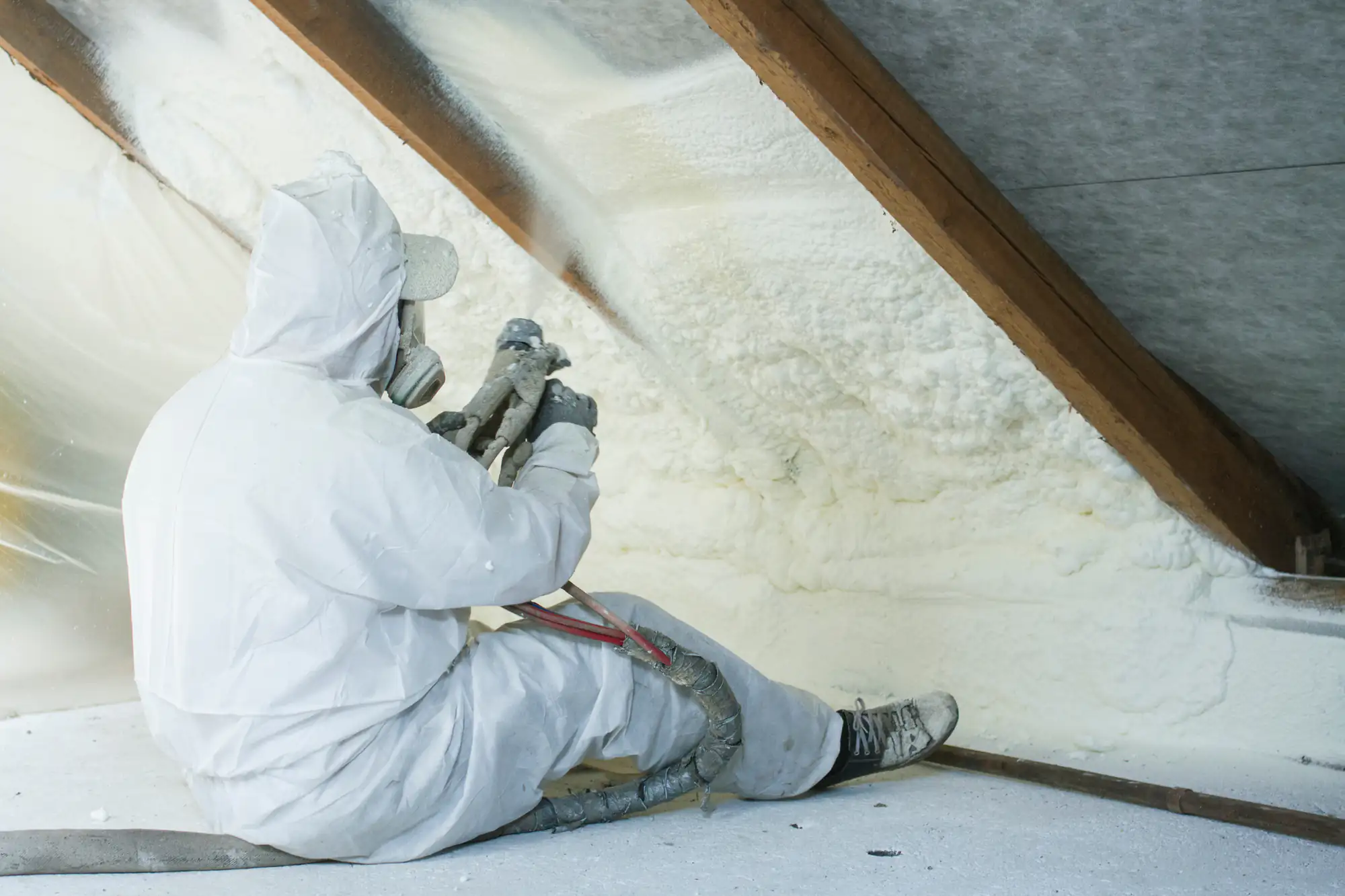
Once the inspection is complete, you’ll get a clear picture of what your roof actually needs. If the existing substrate is structurally sound and dry, foam can often be applied directly over it — no tear-off, no dumpster in the driveway, no extended disruption to your home or business. The foam is sprayed on as a liquid, expands to fill every contour and gap, and cures into a seamless, rigid surface. A high-reflectivity elastomeric coating is then applied over the foam to protect it from UV exposure and provide the fire-resistance rating required under Chandler’s adopted 2024 International Building Code.
The best installation windows in Chandler are spring — April through early June — and fall, particularly October and November, when temperatures have moderated after monsoon season and humidity is low. Foam application requires temperatures above 55°F and controlled moisture conditions, and Chandler’s shoulder seasons hit those marks reliably. If you’re coming off a rough monsoon season and your flat roof showed it, fall is the time to move.
Ready to get started?
We install complete spray polyurethane foam roofing systems for both residential and commercial properties across Chandler and Maricopa County. On the residential side, that means homes in communities like Ocotillo, Dobson Ranch, Sun Lakes, and Fulton Ranch — many of which have flat or low-slope rooflines that are architecturally well-suited to foam and where aging roofing systems are increasingly reaching end of life. For Sun Lakes residents in particular, the combination of single-story flat roofs, fixed-income energy budgets, and Chandler’s summer electricity costs makes foam roofing one of the more financially straightforward upgrades available.
On the commercial side, the Price Corridor’s concentration of office buildings, medical facilities, light industrial properties, and tech campus buildings creates a significant inventory of flat-roofed structures where foam roofing delivers its most dramatic results. A 20,000 square foot commercial building in Chandler can realistically save $8,400 or more annually in cooling costs after a foam roof installation — with a typical payback period of three to four years.
We provide new foam roof installation, foam roof repair, SPF roof restoration, foam roof recoating and sealing, and spray foam flat roof replacement. Recoating is recommended every five to seven years in Arizona’s UV environment and extends the life of the system significantly — a maintained foam roof can last 30 to 50 years or more. Every installation is backed by our 25-year workmanship warranty and performed under our Arizona ROC C-42 license, which is verifiable at roc.az.gov.
For a typical residential installation in Chandler, spray foam roofing generally runs between $7,000 and $12,000 depending on roof size, condition, and the thickness of foam required. That range puts it in line with or slightly above other flat roof systems like TPO — but the comparison doesn’t end at installation cost. Foam roofing’s insulation value reduces cooling costs by 25 to 35 percent in Arizona’s climate, which on a Chandler home paying $400 or more per month in summer electricity translates to real annual savings. Most residential customers see payback within four to five years from energy savings alone, and the system can last 30 to 50 years with periodic recoating.
We offer financing for customers who want to spread the upfront cost. If you’re in a community like Dobson Ranch or Sun Lakes where homes are older and roofing systems are approaching the end of their lifespan, it’s worth factoring in that foam can often be installed over your existing roof without tear-off — which removes a cost layer that full replacement systems require.
In Chandler’s UV environment, the elastomeric topcoat on a foam roof typically needs to be refreshed every five to seven years. The foam itself doesn’t degrade — it’s the protective coating layer that takes the brunt of Arizona’s intense solar radiation and needs periodic renewal to keep the system performing at full capacity. Skipping recoating doesn’t mean the roof fails immediately, but the foam becomes exposed to UV over time, which will eventually cause surface erosion and compromise the waterproofing layer.
The good news is that recoating is significantly less disruptive and less expensive than any kind of roof replacement. It’s a maintenance investment, not a replacement cycle. Chandler’s dry fall season — October through November — is the ideal window for recoating work, with low humidity and moderate temperatures that allow the coating to cure properly. If your foam roof was installed five or more years ago and hasn’t been recoated, a thermal imaging inspection is a smart starting point to assess the current condition before the next monsoon season arrives.
Both systems work in Arizona, but they perform differently in Chandler’s specific conditions. TPO is a seamed membrane system — it’s installed in sheets that are heat-welded together. Those seams are the system’s vulnerability, and Chandler’s monsoon season — with its microbursts, haboob-driven wind loads, and rapid pressure changes — puts seamed systems under significant stress year after year. Foam roofing is applied as a liquid and cures into a single continuous surface. There are no seams to fail, no joints for water to find, and no fasteners to back out under thermal expansion.
On the insulation side, foam delivers R-6 to R-7 per inch — far above what TPO provides on its own. For a Chandler building where cooling accounts for the dominant share of energy costs from April through October, that insulation difference is measurable on your utility bill. TPO can be a reasonable choice in some applications, but for flat-roofed homes and commercial buildings in Chandler’s climate, foam roofing’s combination of seamless waterproofing and superior thermal performance is a meaningful structural advantage.
It’s one of the strongest arguments for foam in this specific market. Chandler’s monsoon season runs from June 15 through September 30, and the storms that move through the East Valley during that window are not mild. Haboobs — the dust walls driven by outflow winds from collapsing thunderstorms — bring sustained high winds that stress every seam and joint on a conventional flat roof. Microbursts deliver sudden, intense downward pressure followed by horizontal wind loads. Heavy rain follows almost immediately, and any opening in a roof system becomes a water entry point fast.
Foam roofing’s seamless, monolithic construction means there’s nothing for those wind loads to pry apart and no joint for monsoon-driven water to find. The system also adheres directly to the substrate rather than being mechanically fastened, which removes the fastener-backed-out failure mode that affects other flat roof systems over time. If you’ve had a flat-roofed home or commercial building in Chandler for more than a few years and dealt with post-monsoon leaks, that pattern is almost always traceable to seam or joint failure — the exact problem foam roofing eliminates.
In most cases, yes — and that’s one of the practical advantages of foam roofing that doesn’t get enough attention. As long as your existing roof substrate is structurally sound and free of trapped moisture, spray foam can be applied directly over it. No tear-off means no dumpster, no landfill fees, no days of noise, and no disruption to your landscaping or business operations. For commercial property managers along Chandler’s Price Corridor whose tenants can’t absorb extended downtime, this is a real operational advantage.
The moisture question is where the thermal imaging inspection earns its value. Before any foam installation, we use thermal imaging to confirm there’s no hidden moisture trapped in the existing roofing layers. If moisture is present and gets sealed under foam, it becomes a bigger problem. When the substrate is clean and dry, the foam bonds directly to it and the result is a system that’s actually better integrated with the building than a mechanically fastened replacement would be. Your project scope — and whether tear-off is needed at all — gets determined at the inspection stage, not after work has started.
Arizona requires an ROC C-42 Roofing License to legally install urethane foam roofing — it’s not a general contractor license or a broad construction license. It’s a specific classification that covers urethane foam and roof coatings, and it’s required by state law for any foam roofing work performed in Chandler. You can verify any contractor’s license status in seconds at roc.az.gov by searching the company name or license number. It’s a free public database and takes less than a minute to use.
This matters more than it might seem. Unlicensed foam roofing work in Chandler can void your homeowner’s insurance coverage for roof-related claims, create code violations on your property record, and leave you with no legal recourse when the installation fails — because the contractor operating without a license has no accountability structure to hold them to. Maricopa County sees an influx of unlicensed contractors after major monsoon events, and foam roofing is one of the categories they target. Our Arizona ROC C-42 license is current and verifiable. Ask any contractor you’re considering for their license number before signing anything, and take the 60 seconds to confirm it’s active.
Other Services we provide in Chandler